


Recent statements from Google suggest that backlinks may not be as significant a ranking factor as previously believed. However at the same time, it’s also known that Google’s claims about their algorithm are not always true.
It is commonly known that the importance of backlinks depends on what you are trying to rank for. For example, to rank for long-tail informational keywords would not require as many backlinks to be created like when trying to rank for short-tail commercial keywords which come with a more competitive landscape as well as higher search volumes.
With that in mind, do we really need only a few links to rank within the top 10 on Google?
Internet Marketing Ninjas set out to conduct a study to answer this question. They used AI to generate over 200 commercial intent search terms. From that, they then studied the 1113 websites which appeared in the search results thereafter. These 1,113 websites were the collection of the top 10 organic search results for the 200 keywords used. From these websites the number of backlinks each one had, was then calculated.
The results:
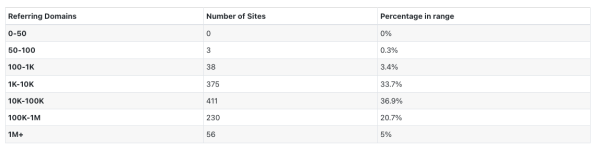
To get straight to the results, of the 1,113 websites that were analysed 96% of them had over 1,000 unique domain backlinks. And to reiterate, these websites were in the top 10 of Google’s search results for the 200 keywords analysed.
Some other findings were:
- None of these sites had less than 50 unique domain backlinks going to them.
- Only 3 out of 1,113 sites (0.03%) had between 50 and 100 backlinks.
- Only 38 out of 1,113 sites (3.4%) had between 100 and 1,000 unique domain backlinks.
The table below lists these findings further, however from what was found it can be said that backlinks are in fact an important ranking factor despite what Google has been alluding to recently.
Other important insights:
Amongst the sites that had the lowest rankings (the 3 sites mentioned above), these sites had around 50-100 backlinks and were ranking on average at position 6. This is still a substantial number of backlinks and therefore only reinforcing the finding that backlinks are an important ranking factor. What this data also tells us, is that one would need between 50-100 backlinks minimum to rank within the top 10 search results which is still a substantial number.
Another interesting find from the study was that Amazon completely dominated the search results, where they ranked within the top 10 for 164 of the 200 keywords. To add to that, Amazon has over 15 million backlinks. Walmart came a close second, where they ranked in the top 10 for 54 of the 200 keywords with over 1 million backlinks.
Not all links are equal
The study did note that it is important to keep in mind that not all links share the same value.
A link’s value can be determined by:
- The authority of the linking website
- The number of clicks it gets
- The anchor text linking back to you
- If there is an author on the page, and how trusted they are.
However, despite not all links being equal, the researcher still did not find a site out of the 1,113 analysed, with a significantly small number of backlinks.
Why do we care?
To go back to our initial question of whether or not backlinks are important to rank within the top 10 positions on Google, taking into consideration that 96% of websites that do rank in those positions have over 1000 backlinks, it can be said that backlinks are a substantially important ranking factor. It is important to also note that it is not the most important ranking factor. The quality of your content, the technical set-up of your site and user experience still remain important, however ensuring that you have a solid backlinking strategy in place is an imperative cornerstone to any SEO strategy and to ultimately ensure your website ranks within the top 10 positions of Google.