


After months of rumors, Google has officially announced the launch of AI mode. This is not the same as AI Overviews, but just like AI Overviews, AI Mode signals a shift in how users experience search and how publishers may earn visibility in an AI-driven landscape.
For now, AI Mode is still being tested. It is only available to users paying for Google One AI Premium, and even these users will have to enable it in the Labs section of Search.
What is AI Mode?
AI Mode is essentially Google’s version of Perplexity or Chat GPT. The premise behind AI Mode is that many people searching on Google would prefer to have their results be primarily AI-generated. If you switch to AI Mode, which is a tab in the search results page, just like Images or News, and enter a query, you’ll get back a generated answer, based on everything in Google’s search index, with a few supporting links added throughout.
The way AI Mode generates its answers is through a technique called “query fan-out”. This essentially breaks down each query it receives, runs many sub-queries in the background, and then pieces together the “best answer”.
The user experience feels a little like any other AI-driven search engine, but you’re interacting with a search-specific model, which means it’s more able to tap real-time data and interact directly with the web. This potentially means that because AI Mode has direct access to Google’s in-depth data, this search function should be able to produce more comprehensive answers than other AI search engines.
AI Mode also supports queries made through text, voice or images.
What will AI Mode look like?
Here is a snapshot of how AI Mode will look on a desktop.

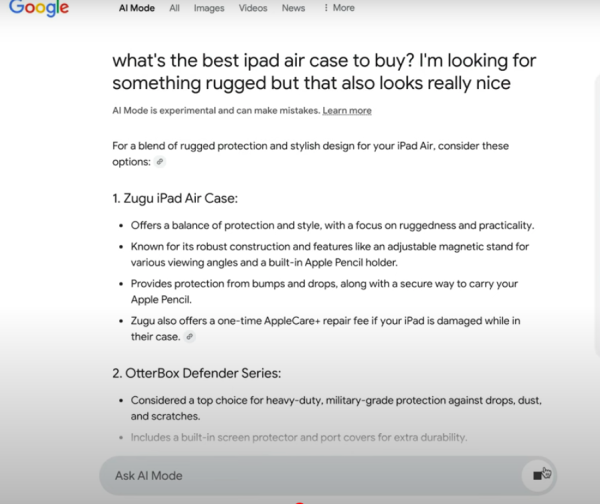
At first glance, it seems very similar to AI Overviews, with the search bar at the top and as mentioned, it provides links throughout the answers generated.
Many first-time users have explained that the answers AI Mode currently provides are of good quality, and answers are provided at a great speed, however, some first-time users have also noticed a few shortfalls of AI Mode’s answers.
As mentioned earlier in this post, the one benefit AI Mode can have over other AI-driven search engines is that it can pull directly from its own extensive data set, providing users with more comprehensive answers. First-time users have noted that it does not appear that AI Mode is currently doing this, specifically when it comes to its shopping data.
For example, when searching for a product to purchase, AI Mode appears to be pulling its answers from high-ranking, authoritative third-party sites. Links to these articles are provided, rather than creating a link to the manufacturer itself, as well as a link to purchase the product.
It also appears that AI Mode does not have access to local pack data. When conducting local search queries, local map packs are not provided in AI Mode but rather provide an answer typical of that of an organic search result.
As mentioned, AI Mode is still in its infant days and therefore, shopping data (such as providing a “buy now” button) and local pack information may be incorporated into AI Mode at a later stage.
On the flip side
AI Mode might suggest that Google feels threatened by Perplexity or Chat GPT stealing their market share, however, the data tells us a different story.
Google saw 373 times more searches than ChatGPT in 2024, with a 93.57% market share compared to ChatGPT’s 0.25%. That’s less than Microsoft Bing (4.10%), Yahoo (1.35%), and DuckDuckGo (0.73%). Additionally, the number of Google searches grew by 21.64% in 2024, compared to 2023.
This data confirms that users still heavily rely on Google for real-time information and comprehensive results, therefore, the importance of traditional SEO still stands.
However, it is also important to highlight that AI Overviews contributed to the increased search usage in 2024 and because of this, an estimated 60% of Google searches in 2024 ended without a click, suggesting evolving user behavior in the search landscape.
Why we care
AI Mode is just the latest signal of how important AI search has become to Google, and how important it is to adapt your digital marketing strategy accordingly. Despite this new age of AI-driven search engines, the fundamentals of traditional SEO still stand, and that is to ensure that your content ranks in normal Google searches. At the end of the day, when AI Mode “fans out” to create answers, it looks through what is ranking well on Google.
However, as AI search engines rapidly evolve and click-through rates shift, adaptability is still important for digital marketers. To remain competitive, it’s crucial to analyse the types of answers AI Mode generates and the sources it references, allowing you to develop hybrid content strategies that combine traditional SEO with AI-optimized content, such as getting your products featured in third-party articles that AI Mode might refer to.